


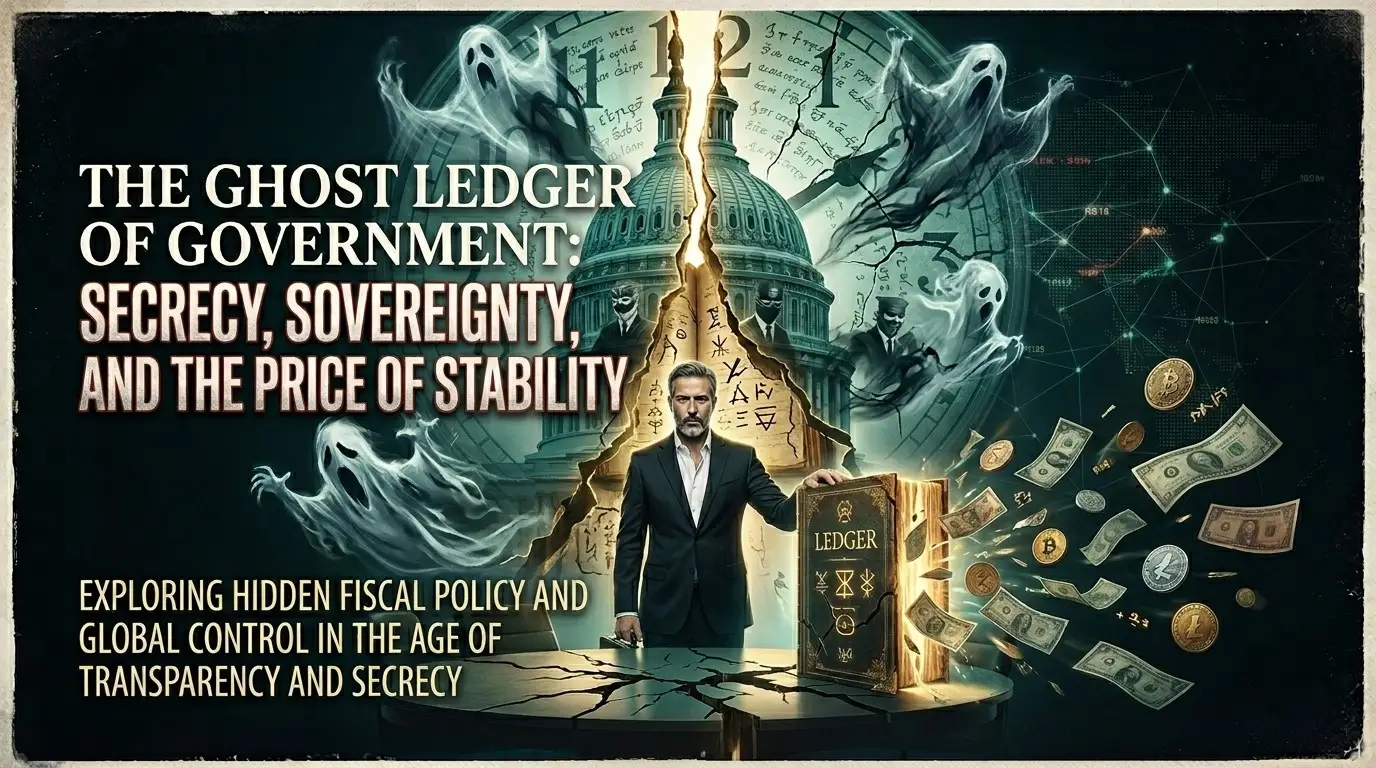
What happens when the most important financial decisions in the world are made outside the public eye? This question lies at the heart of one of the most intriguing ideas in Good Country, Bad Balance Sheet: the existence of a “ghost ledger”—a hidden layer of financial reality that operates parallel to the official system.
While the concept is dramatized in the novel, it reflects a deeper truth about modern governance. Not all decisions that shape economic stability are visible, and not all mechanisms of control are formally documented. In times of crisis, secrecy can become a tool—not just of power, but of preservation.
Understanding the Idea of a “Ghost Ledger”
Beyond the Official Record
In its simplest form, a ledger is a record of transactions—a transparent account of what exists and how it changes over time. Governments maintain such records to track debt, obligations, and financial flows. These records form the foundation of public trust and accountability.
The idea of a “ghost ledger” challenges this transparency. It suggests the existence of decisions, adjustments, or understandings that are not fully reflected in official accounts. These may include informal agreements, coordinated interventions, or strategic omissions designed to maintain stability.
While this may sound conspiratorial, it is better understood as a reflection of complexity. Not every action can be fully disclosed in real time without risking unintended consequences.
Why Secrecy Exists in Financial Systems
Secrecy in financial systems is not inherently malicious. In many cases, it is a response to the delicate nature of markets. Information can move prices, trigger reactions, and amplify risk. Full transparency, while ideal in principle, can sometimes create instability in practice.
This creates a paradox. The systems that rely on trust and openness may also require discretion to function effectively. The challenge lies in balancing these competing needs.
Sovereignty and Control
Who Owns the System?
At the sovereign level, financial systems are deeply intertwined with political authority. Governments have the power to issue debt, regulate markets, and influence economic outcomes. This authority is central to sovereignty.
However, as systems become more complex and interconnected, control becomes less absolute. Markets, institutions, and global actors all play a role in shaping outcomes. Sovereignty, in this context, becomes a shared space rather than a singular authority.
The concept of a ghost ledger reflects this shift. It highlights the reality that control is often exercised through coordination rather than command.
The Limits of Transparency
Transparency is a cornerstone of democratic systems, but it has limits. Certain decisions—particularly those involving national security or financial stability—are made with restricted visibility.
In moments of crisis, these limits become more pronounced. Governments may act quickly, using tools and strategies that are not immediately disclosed. The intention is to stabilize the system before information can trigger further disruption.
This does not eliminate the need for accountability, but it complicates how and when that accountability is exercised.
The Price of Stability
Trade-Offs Between Openness and Control
Maintaining stability often requires trade-offs. Greater transparency can enhance trust, but it can also introduce volatility. Secrecy can prevent panic, but it can also erode confidence if discovered later.
The ghost ledger concept captures this tension. It suggests that stability is not achieved through a single approach, but through a dynamic balance between openness and control.
Trust as a Fragile Asset
Trust is one of the most valuable assets in any financial system. It underpins investor behavior, supports currency value, and enables long-term planning. Once compromised, it is difficult to restore.
Secrecy, when used carefully, can protect trust by preventing unnecessary disruption. However, if it crosses into deception, it can have the opposite effect. The line between these outcomes is often thin and difficult to navigate.
Real-World Parallels
Coordinated Interventions
In reality, governments and central banks have occasionally acted in coordinated ways to stabilize markets. These actions may not always be fully transparent at the time, but they are often revealed later through reports, disclosures, or historical analysis.
Such interventions highlight the practical need for discretion in managing complex systems. They also demonstrate that the idea of unseen coordination is not entirely fictional.
Financial Engineering and Policy Tools
Modern financial systems are supported by a wide range of tools, including monetary policy, regulatory frameworks, and market operations. These tools can be used in combination to achieve specific outcomes.
The novel’s portrayal of hidden mechanisms amplifies this reality, suggesting a level of coordination that is more dramatic than typical practice, but rooted in real capabilities.
Why the Concept Resonates
A Reflection of Modern Complexity
The idea of a ghost ledger resonates because it reflects the complexity of modern financial systems. It acknowledges that not all processes are visible and that some level of abstraction exists between official narratives and operational realities.
This does not imply wrongdoing, but rather highlights the challenges of managing systems that operate at a global scale.
A Narrative Device with Real Insight
As a narrative device, the ghost ledger adds intrigue and tension to the story. As a concept, it provides insight into how systems function under pressure. It encourages readers to think critically about the relationship between visibility and control.
Conclusion: The Hidden Layer of Stability
The ghost ledger may be fictional, but the ideas it represents are grounded in reality. Financial systems are complex, interconnected, and sensitive to perception. Managing them requires a combination of transparency, discretion, and coordination.
Good Country, Bad Balance Sheet uses this concept to explore the hidden mechanisms that support stability, reminding readers that what is visible is only part of the story.
In the end, the price of stability may include decisions that are not immediately seen or understood. The challenge is ensuring that these decisions ultimately serve the public good, preserving not just the system itself, but the trust that allows it to function.