


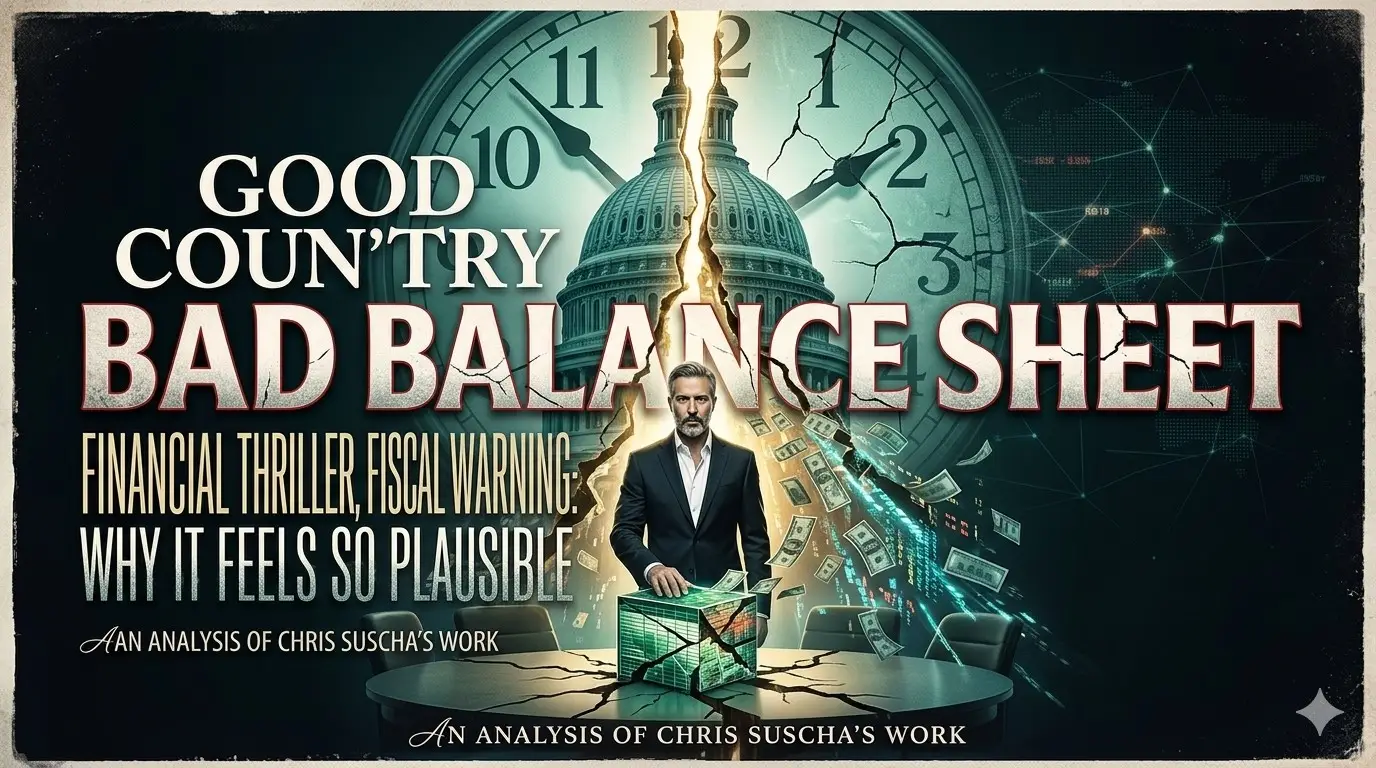
Some novels entertain. Others provoke. And then there are rare stories that do both—while leaving readers with an unsettling question: what if this could actually happen?
Good Country, Bad Balance Sheet operates precisely in that space. On the surface, it is a high-stakes financial thriller filled with secret deals, market manipulation, and global urgency. Beneath that narrative, however, lies something more serious—a fiscal warning grounded in real-world financial logic.
What makes the story so compelling is not just its pace or its characters, but its plausibility. It feels close enough to reality to be uncomfortable. And that is exactly the point.
The Power of a Realistic Premise
A Crisis That Feels Familiar
The novel begins with a premise that does not feel far removed from current economic conversations: a nation approaching a debt threshold that may no longer be sustainable. While the timeline is accelerated for dramatic effect, the underlying concern reflects ongoing debates about sovereign debt, fiscal policy, and long-term economic stability.
This familiarity anchors the story. Readers are not asked to imagine an entirely fictional world, but rather a slightly intensified version of the one they already recognize. That proximity to reality is what makes the narrative resonate.
Grounded in Financial Logic
Unlike many thrillers that rely on abstract or exaggerated concepts, this story draws heavily from the mechanics of real financial systems. Concepts such as debt restructuring, market signaling, and institutional coordination are presented in ways that align with how these systems actually function.
The manuscript’s foundation in restructuring experience reinforces this realism, highlighting how balance sheets—not just operations—determine outcomes. This grounding makes the narrative feel less like speculation and more like a plausible extension of existing dynamics.
Why the Story Feels Possible
The Fragility of Complex Systems
Modern financial systems are highly interconnected. Markets, institutions, and governments are linked through layers of obligations and expectations. This complexity creates efficiency, but it also introduces fragility.
Small disruptions can have amplified effects, particularly when confidence is involved. The novel captures this dynamic by showing how quickly conditions can shift once uncertainty enters the system. While dramatized, the principle is consistent with real-world market behavior.
Speed as a Defining Feature
Another element that enhances plausibility is the emphasis on speed. Financial markets operate at an extraordinary pace, with information and capital moving across the globe in seconds. Decisions that once took days or weeks can now unfold almost instantly.
The narrative compresses events into a rapid timeline, but this compression reflects a broader truth: in modern finance, change can occur far faster than traditional frameworks are designed to handle.
The Role of Institutions and Power
Concentrated Decision-Making
One of the more realistic aspects of the story is its focus on how a relatively small group of actors can influence large-scale outcomes. Central banks, treasury departments, and major financial institutions hold significant power within the system.
In times of stability, this concentration may not be obvious. In times of stress, it becomes more visible. Decisions made by a handful of institutions can shape market direction, influence investor behavior, and determine the trajectory of economic events.
Coordination Under Pressure
The novel emphasizes coordination as a critical factor in managing crisis. While the level of secrecy depicted is fictional, the need for alignment among key players is very real. Without coordination, even well-designed interventions can fail.
This reflects a broader truth about financial systems: they are not self-correcting in isolation. They require deliberate action, often under significant pressure, to maintain stability.
Why the Warning Matters
Beyond Entertainment
The novel’s greatest strength lies in its ability to function as both entertainment and analysis. While readers are drawn in by the plot, they are left with questions about the real-world implications of what they have read.
This dual role makes the story particularly effective. It engages without overwhelming, using narrative to explore complex ideas in an accessible way.
A Reminder of Structural Reality
At its core, the story is a reminder that financial systems are governed by structure. Growth, innovation, and policy all operate within the constraints of the balance sheet. When those constraints become binding, they influence outcomes in profound ways.
As the manuscript suggests, ignoring these realities does not eliminate them. It simply delays the moment when they must be addressed.
Conclusion: Fiction That Feels Uncomfortably Real
Why does Good Country, Bad Balance Sheet feel so plausible? Because it is built on truths that already exist. The mechanisms may be dramatized, the timeline compressed, and the characters fictional, but the underlying logic is real.
It is a story about debt, power, and the delicate balance that holds financial systems together. More importantly, it is a reminder that stability is not guaranteed—it is managed, maintained, and sometimes tested.
In the end, the novel succeeds not just as a thriller, but as a warning. It invites readers to look beyond the surface of economic strength and consider the structures that support it. And in doing so, it leaves a lasting impression: that the line between fiction and reality may be thinner than we would like to believe.