


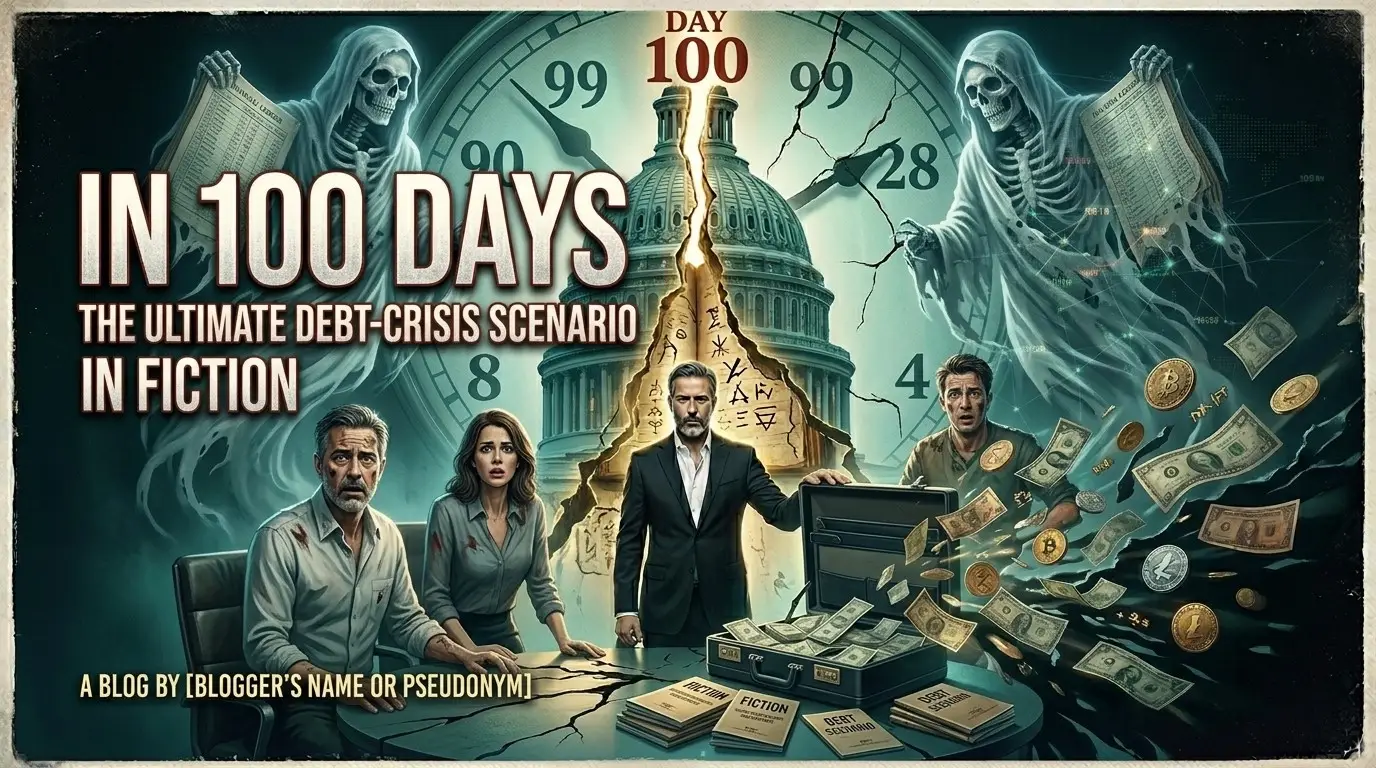
What would happen if the United States were given a fixed deadline to avoid default? Not a vague long-term concern, but a hard, ticking clock—one hundred days to stabilize the largest balance sheet in history. This is the high-stakes premise that drives Good Country, Bad Balance Sheet, transforming an abstract economic risk into an urgent, time-bound crisis.
While the scenario is fictional, the underlying question is very real: how would a modern financial system respond under extreme time pressure? Exploring this idea reveals not just the mechanics of crisis, but the fragile balance that sustains global markets.
The Power of a Deadline
Why Time Changes Everything
In most discussions about national debt, timelines are long and uncertain. Governments plan over years or decades, and risks evolve gradually. By introducing a fixed 100-day countdown, the novel forces a shift in perspective. Time becomes the central constraint, compressing decisions that would normally unfold slowly into an intense, high-pressure window.
This compression highlights a key truth: financial systems behave very differently under time constraints. Decisions become more decisive, coordination becomes more urgent, and the margin for error shrinks dramatically.
Urgency as a Catalyst for Action
A defined deadline eliminates the ability to delay. In real-world policy, postponement is often the default response to complex problems. Deadlines disrupt that pattern, forcing stakeholders to confront issues directly.
The narrative uses urgency as a catalyst, showing how quickly priorities can shift when inaction is no longer an option. While dramatized, this reflects how crises often accelerate decision-making in reality.
What Default Really Means
Beyond Missed Payments
Default is commonly understood as a failure to meet financial obligations, but its implications go far beyond missed payments. At the sovereign level, default represents a breakdown in trust. It signals to markets that the system can no longer guarantee its commitments.
This loss of confidence can trigger a cascade of effects, including rising borrowing costs, capital flight, and economic instability. Even the perception of default risk can be enough to create significant disruption.
The Systemic Impact
The United States occupies a central position in the global financial system. Its debt instruments are widely held and used as benchmarks for pricing risk across markets. A default event, even a temporary one, would have far-reaching consequences.
The novel captures this interconnectedness by illustrating how quickly a localized issue can become a global concern. While the scale is amplified, the principle is accurate: in a highly integrated system, shocks do not remain contained.
The Mechanics of a Crisis Scenario
Coordination Under Pressure
One of the most compelling aspects of the 100-day scenario is the emphasis on coordination. Stabilizing a system of this scale requires alignment across multiple institutions, including governments, central banks, and financial markets.
In reality, such coordination is complex and often difficult to achieve. Differing priorities, incentives, and constraints can slow down decision-making. The novel accelerates this process, but the underlying requirement remains consistent with real-world dynamics.
Financial Engineering as a Tool
The story explores the use of financial engineering to manage crisis conditions. By restructuring obligations, creating new instruments, and altering incentives, the system is adjusted without triggering immediate collapse.
This approach reflects how modern financial systems often rely on innovation to address challenges. While the specific mechanisms may be fictionalized, the broader strategy is grounded in reality.
Market Behavior in Extreme Conditions
Volatility and Reaction
Under normal conditions, markets operate with a degree of predictability. In crisis scenarios, that predictability diminishes. Volatility increases, and reactions become more sensitive to new information.
The 100-day timeline amplifies this effect, showing how quickly sentiment can shift. While the pace is heightened for narrative purposes, it reflects the reality that markets can respond rapidly when confidence is at stake.
The Role of Perception
In high-pressure environments, perception often matters as much as reality. Investors make decisions based on expectations, and those expectations can change quickly.
The novel demonstrates how managing perception becomes a critical part of crisis response. Communication, signaling, and timing all play a role in shaping outcomes.
Fiction vs. Reality
The Limits of the Scenario
While the 100-day default scenario is compelling, it is important to recognize its limitations. Real-world crises are rarely defined by precise timelines. They develop through a combination of factors, often without a clear starting point or deadline.
Additionally, the level of control depicted in the novel may not be fully achievable in practice. Financial systems are influenced by a wide range of actors, making outcomes inherently uncertain.
The Value of the Thought Experiment
Despite these limitations, the scenario provides valuable insight. By exploring an extreme case, it highlights the mechanisms and pressures that shape financial systems.
It also encourages readers to think critically about how crises unfold and how they might be managed.
Conclusion: A Clock That Reveals the System
The idea of default in 100 days may be fictional, but it serves as a powerful narrative device. It transforms a complex, long-term issue into an immediate challenge, revealing how systems behave under pressure.
Good Country, Bad Balance Sheet uses this scenario to explore the dynamics of debt, coordination, and market psychology, offering a perspective that is both engaging and thought-provoking.
In the end, the value of the story lies not in predicting a specific outcome, but in illustrating how fragile stability can be when time is no longer on your side. It reminds us that financial systems are not just defined by their size or strength, but by their ability to respond when the clock starts ticking.